A 3-Step Framework for Running an AI Competitive Analysis for Social Media
Learn how to run ai competitive analysis for social media, choose the right assistant, and turn competitor data into practical next steps.


An AI competitive analysis helps you turn competitor data into faster, clearer decisions. It cuts the time spent collecting posts, tagging themes, and comparing benchmarks, while leaving strategy in your hands.
But the point of using AI in your competitive analysis is not to automate judgment away. The point is to make the analysis faster so you can spend more time deciding what to do next.
In this guide, together with Elmira Gazizova, AI Adoption Lead & Marketing Executive at keyIT sa, I'll show you how to use AI where it adds real value, and how to keep the results trustworthy.
Key takeaways
- AI turns competitive analysis from a time-consuming reporting exercise into a continuous, faster decision-making process by surfacing patterns and insights at scale.
- AI accelerates competitive analysis by helping teams organize data, compare competitors, and generate testable insights while keeping strategic decisions in human hands.
- AI is most valuable for uncovering positioning gaps, reverse-engineering competitor strategies, and forecasting potential market opportunities.
How is AI transforming the process of running a competitive analysis?
At a simple level, competitor insights used to mean collecting posts, exporting data, and building a summary by hand. Now, AI can help you scan larger sets of content, surface patterns, and translate the raw data into a shortlist of next steps.
AI is turning competitive analysis from a periodic reporting task into a continuous decision-making habit. Instead of waiting for a monthly audit, you can ask better questions as soon as a competitor changes format, messaging, or cadence.
Here's Elmira's perspective as well:
AI has significantly reduced the effort required to gather information about markets and competitors. Access to data is faster, broader, and more continuous than before, which lowers the barrier to entry across industries. As a result, the real advantage is no longer access to information, but speed of interpretation and reaction.
What AI does well, and what it does not
AI is excellent at speed, scale, and pattern recognition. It can process large volumes of posts, spot recurring themes, and show you where performance shifts start to appear. It is also useful for summarizing competitor moves into something a team can discuss quickly.
However, AI is weaker at context. It does not know your internal constraints, channel priorities, or audience nuance unless you give it that information.
How does AI help with an effective competitive analysis in practice?
AI helps in practice when it sits on top of a reliable workflow, not when it tries to replace one. The best results come from pairing a clear question with clean data, then using AI to summarize, compare, and test ideas faster.
Define your objectives and competitors
The first step is to decide what problem you are solving. If the question is “What are competitors doing that we are not?” then your data set should be built around direct, indirect, and aspirational brands.
Each group gives you a different insight:
- Direct competitors show you what winning looks like in your exact category.
- Indirect competitors show you where audience attention goes when your product is not the only option.
- Aspirational brands show you new formats, storytelling styles, or platform habits worth testing.
I like to keep this list short, because too many competitors create noise. If you want a broader workflow, competitor analysis is most useful when the set is small enough to explain in a meeting and large enough to reveal patterns.
Choose the right assistant
The right assistant is the one that fits your data reality. General-purpose tools like ChatGPT, Claude, or Perplexity can help you explore a topic, but they still depend on what you paste in and how well you frame the prompt.
That is why I prefer tools that let me ask questions against an existing competitor dataset instead of rebuilding the inputs every time. In a practical sense, that means less copying, fewer spreadsheets, and a faster path to insight. It also makes the output easier to explain to stakeholders, which matters when the CMO wants a quick answer before the meeting starts. For this, I find particularly effective Socialinsider's MCP.

Test the recommendations and analyze results
AI should propose hypotheses, not final answers. The fastest way to validate AI output is to turn one recommendation into a small test and compare the result with past performance.
For example, when AI suggests a stronger hook, a new format, or a different posting pattern, I recommend running an A/B test where you test one variable at a time so you can see whether the change actually moved the metric you care about.
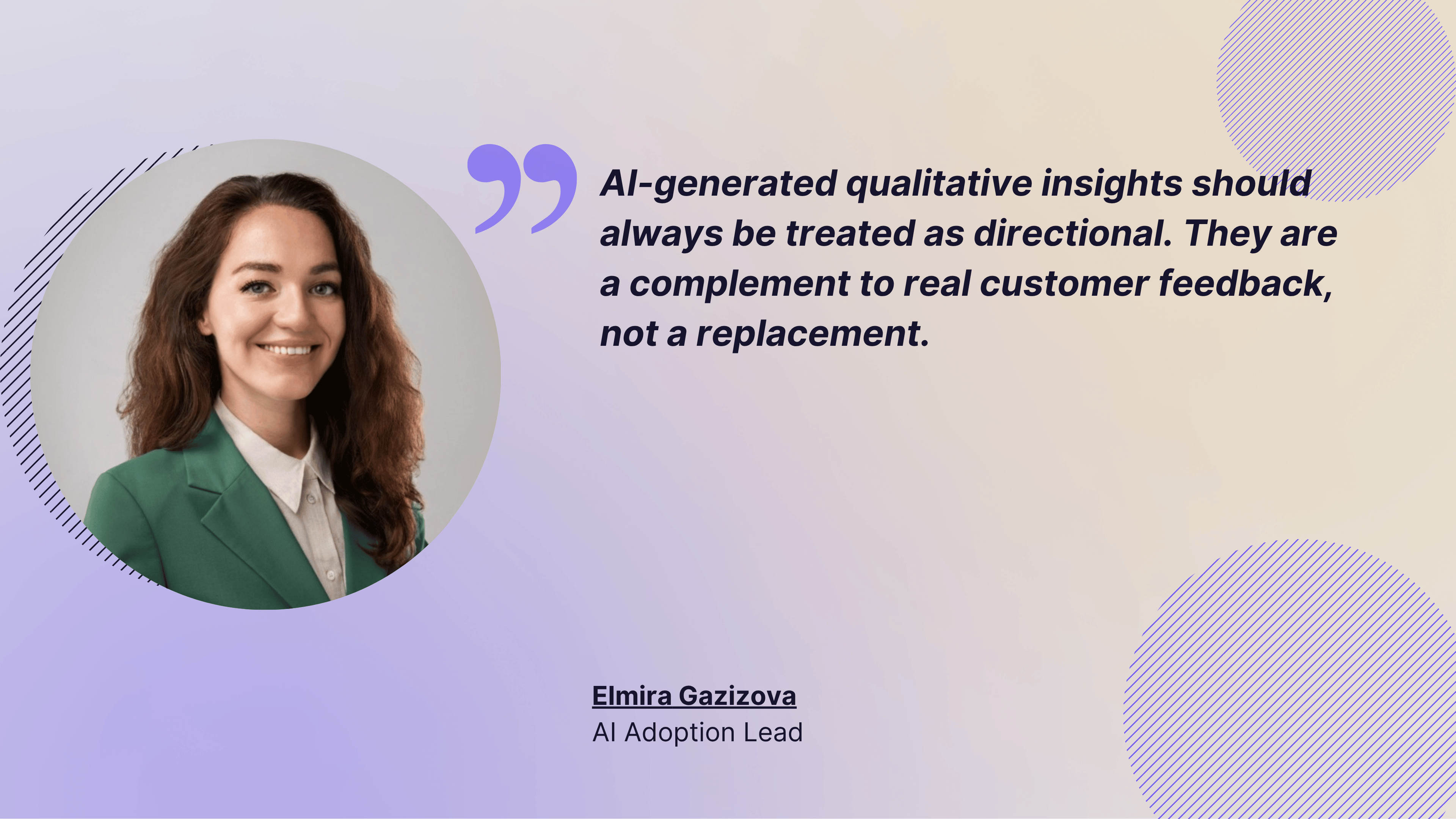
Here's how Elmira leverages AI when it comes to analyzing competitors and how she trates AI-driven insights.
AI-generated qualitative insights should always be treated as directional. They are a complement to real customer feedback, not a replacement.
Common AI competitive analysis use cases
AI is most useful when the task is repetitive, comparative, or pattern-driven. If you only use it for quick summaries, you miss the biggest payoff: turning competitor signals into smarter actions.
Reverse engineering competitor campaign strategies
Use AI when you need to understand why a competitor campaign worked. A good example is a launch burst, a seasonal promo, or a content push that suddenly lifts engagement.
For example, by checking the content mix, posting frequency, and strongest post themes. Then I would ask what happened before the spike, not just during it. If a competitor used creator-led video, then the next step is to test whether your own audience responds to the same structure, the same timing, or a similar topic angle.

The practical outcome is simple: you stop copying surface-level tactics and start understanding the structure behind them.
Finding your competitive positioning gap
AI is useful when your content looks fine on paper, but still loses to a competitor’s message. It can surface differences in framing, format, and audience angle that are easy to miss when you scroll manually.
This is where competitive work becomes strategy work. Maybe a competitor leads with outcomes, while your team leads with features. Maybe they use short social proof captions, while your team uses long explanations. AI can sort those differences quickly, but the decision still belongs to you. If the insight is “They own the outcome story,” the next step is to test a clearer outcome-led hook in your own content and watch whether saves, shares, or click-through rate move.
Performance forecasting
Forecasting is where AI can be helpful without pretending to be magical. It can highlight signals that suggest a content theme, platform shift, or cadence change is gaining momentum, then help you model a few likely outcomes.
For example, I like to treat trend analysis as scenario planning. If a competitor suddenly posts more frequently on TikTok and engagement rises, AI can help you model what happens if your team follows, waits, or ignores the shift. The output is not a promise. It is a way to narrow the field before you spend creative time and budget.

Common mistakes in AI competitive analysis
The most common mistakes are easy to avoid once you know what to look for. The biggest one is treating AI output as a final answer instead of a working draft.
Another mistake is mixing platform logic. LinkedIn, Instagram, TikTok, and YouTube do not behave the same way, so a single raw comparison can lead you in the wrong direction.
A third mistake is doing competitive analysis only once a quarter. That creates a nice report and a weak operating rhythm. If you want the analysis to shape action, keep a regular cadence and use competitor monitoring to spot changes before they become obvious.
When I asked Elmira how she approaches running a competitive analysis using AI, she said:
In practice, I rely less on one-off competitive analysis exercises and more on continuous monitoring. I have set up automated workflows that aggregate news, publications, and competitor signals on an ongoing basis. This allows me to maintain an up-to-date view of the market instead of rebuilding the analysis from scratch once or twice a year.
In fast-moving markets, the ability to detect weak signals early is more valuable than producing a perfect but outdated analysis.
The last mistake is copying a competitor without asking why a specific content pillar worked. If a topic performs well for them, the next question is whether it matches your audience, your offer, and your creative strengths.

That is where strategy comes back in. AI can show the shape of the opportunity, but your team still has to decide whether the opportunity is worth pursuing.
Elmira also mentioned:
Competitive analysis helps understand how others position their offerings, but it should not dictate your strategy. Positioning decisions must be grounded in customer needs, not competitor narratives. Competitive insights are useful to map the landscape. However, differentiation comes from aligning your positioning with real customer outcomes, not from reacting to competitors.
Final thoughts
AI competitive analysis is most useful when it makes your workflow faster without making your thinking shallow. Start with a clear competitor set, clean data, and one question you actually need answered. Then use AI to shorten the path from raw metrics to a decision your team can act on.
If you want a practical place to begin, pick one benchmark report, one campaign, and one test you can run next week. That is usually enough to turn competitive research into a repeatable habit.
Kseniia Volodina
With a background in journalism, Kseniia Volodina writes about social media analytics, audience research, and competitive data for teams that want strategy, not guesswork.

Know what your competitors do — before your manager asks
Get instant social benchmarks & reports without manual work.


